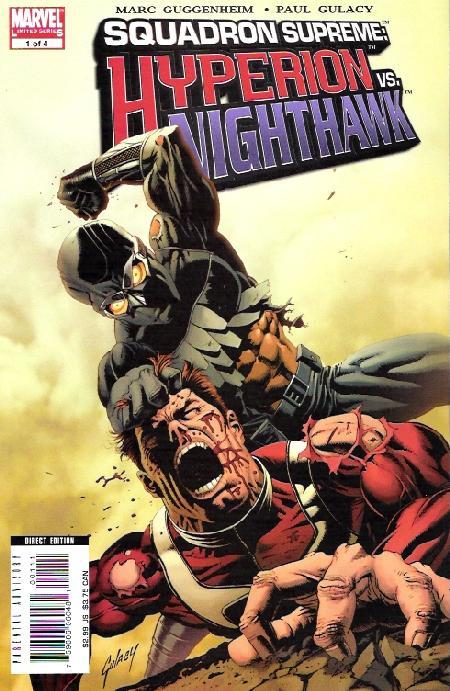
 Writer: Marc Guggenheim, Artist: Paul Gulacy, Publisher: Marvel Comics.
After having enjoyed the first Nighthawk miniseries, I was happy to see him re-appear in this new miniseries. Since the previous series, the original series that it spun off from, SUPREME POWER, had ended and been relaunched as SQUADRON SUPREME, now under the regular Marvel Comics umbrella, instead of the mature-label MAX imprint. In that series, all of the various superhumans had been drafted into a public group, working for the U.S. Government. Nighthawk, not having any superpowers, remained on his own.
This four-issue miniseries attempted to deal with a very serious issue: the genocide and ethnic cleansing in Darfur. While I praise writer Marc Guggenheim for wanting to address this issue, it is a hard thing to deal with in a superhero comic book because there are no superheroes in the real world, and showing them attempting to solve this problem risks minimizing it.
The premise of this series is that Kyle Richmond attempts to help the people of Darfur via his wealth, but finds that his money is ineffective, so he decides to take direct action as Nighthawk by luring Hyperion to the region and forcing him to get involved. Nighthawk breaks into the Squadron Supreme’s HQ at the famous Wright-Patterson Air Force base, where he is confronted by Hyperion. After a brief and one-sided fight (Nighthawk is clearly no match for Hyperion, despite the little gadgets he brought with him), Nighthawk makes his way to Darfur, where he begins killing dozens of the invaders. This leads the military to send Hyperion to Darfur to stop Nighthawk, but when he gets there, suddenly Nighthawk is able to beat up Hyperion with his bare hands. After being knocked unconscious, Hyperion reluctantly agrees to follow Nighthawk’s orders until he can figure out how the heck Nighthawk is able to hurt them. The two of them go on a rampage across the nation, fighting invaders, leading directly to the heart of Darfur’s government.
Again, I praise Guggenheim’s motives in writing this story, but I wish I could say the same for the actual content. First, as I mentioned in the previous review, the major point of these characters is that they exist in a more “real world” environment, yet Guggenheim writes them more like a traditional superhero comic. Of course, these two characters are analogs of Superman and Batman, and most of the time, when those characters are shown fighting in the comics, Batman wins through some clever planning. This leads far too many delusional comic-book geeks to assert that Batman should always be able to beat Superman. But someone with Superman’s powers should “realistically” be able to defeat Batman in a microsecond, before Batman even has time to blink. The only reason he ever beats Superman is because comic book writers have always had Superman refrain from effectively using his powers, especially his speed. Guggenheim does the same here with Hyperion.
There is a scene in Darfur where Nighthawk is in a jeep, and he sees Hyperion flying towards him. So Nighthawk pulls out a rocket launcher and shoots Hyperion in the chest. Of course it doesn’t hurt Hyperion, but why was he even flying slow enough for Nighthawk to see him coming? He could have just zipped down and grabbed him before Nighthawk knew what was happening. Another superhero conceit that Guggenheim employs, although I suppose this could be blamed on the artist, is that even though Hyperion isn’t harmed by the rocket launcher, his outfit should be ripped and burned to pieces. It’s just regular material, not “unstable molecules” or invulnerable Kryptonian cloth. The same happens later, when Hyperion gets shot at with guns, there are no bullet holes in his costume.
Another thing I don’t like is that neither hero was particularly bloodthirsty before. Yet in this issue, Nighthawk is driving around shooting people with machine guns, and Hyperion is burning people with heat vision and snapping necks. Yes, the people they are killing are all really bad guys, but they were still too casual about it, in my opinion, as this was something that neither character did in the regular series. Daniel Way established in the previous miniseries that Nighthawk, unlike Batman, is willing to cross the line and kill if he believes it’s necessary, but he’s not The Punisher.
I will say that the method Nighthawk uses to hurt Hyperion is kind of inventive, although still flawed. Hyperion’s speed should still enable him to dodge Nighthawk’s punches. I can’t say much in praise of Paul Gulacy’s artwork either. None of the characters seems to show much emotion on their faces. So I’m afraid that, overall, I cannot recommend this series.
Squadron Supreme: Hyperion Vs. Nighthawk
Writer: Marc Guggenheim, Artist: Paul Gulacy, Publisher: Marvel Comics.
After having enjoyed the first Nighthawk miniseries, I was happy to see him re-appear in this new miniseries. Since the previous series, the original series that it spun off from, SUPREME POWER, had ended and been relaunched as SQUADRON SUPREME, now under the regular Marvel Comics umbrella, instead of the mature-label MAX imprint. In that series, all of the various superhumans had been drafted into a public group, working for the U.S. Government. Nighthawk, not having any superpowers, remained on his own.
This four-issue miniseries attempted to deal with a very serious issue: the genocide and ethnic cleansing in Darfur. While I praise writer Marc Guggenheim for wanting to address this issue, it is a hard thing to deal with in a superhero comic book because there are no superheroes in the real world, and showing them attempting to solve this problem risks minimizing it.
The premise of this series is that Kyle Richmond attempts to help the people of Darfur via his wealth, but finds that his money is ineffective, so he decides to take direct action as Nighthawk by luring Hyperion to the region and forcing him to get involved. Nighthawk breaks into the Squadron Supreme’s HQ at the famous Wright-Patterson Air Force base, where he is confronted by Hyperion. After a brief and one-sided fight (Nighthawk is clearly no match for Hyperion, despite the little gadgets he brought with him), Nighthawk makes his way to Darfur, where he begins killing dozens of the invaders. This leads the military to send Hyperion to Darfur to stop Nighthawk, but when he gets there, suddenly Nighthawk is able to beat up Hyperion with his bare hands. After being knocked unconscious, Hyperion reluctantly agrees to follow Nighthawk’s orders until he can figure out how the heck Nighthawk is able to hurt them. The two of them go on a rampage across the nation, fighting invaders, leading directly to the heart of Darfur’s government.
Again, I praise Guggenheim’s motives in writing this story, but I wish I could say the same for the actual content. First, as I mentioned in the previous review, the major point of these characters is that they exist in a more “real world” environment, yet Guggenheim writes them more like a traditional superhero comic. Of course, these two characters are analogs of Superman and Batman, and most of the time, when those characters are shown fighting in the comics, Batman wins through some clever planning. This leads far too many delusional comic-book geeks to assert that Batman should always be able to beat Superman. But someone with Superman’s powers should “realistically” be able to defeat Batman in a microsecond, before Batman even has time to blink. The only reason he ever beats Superman is because comic book writers have always had Superman refrain from effectively using his powers, especially his speed. Guggenheim does the same here with Hyperion.
There is a scene in Darfur where Nighthawk is in a jeep, and he sees Hyperion flying towards him. So Nighthawk pulls out a rocket launcher and shoots Hyperion in the chest. Of course it doesn’t hurt Hyperion, but why was he even flying slow enough for Nighthawk to see him coming? He could have just zipped down and grabbed him before Nighthawk knew what was happening. Another superhero conceit that Guggenheim employs, although I suppose this could be blamed on the artist, is that even though Hyperion isn’t harmed by the rocket launcher, his outfit should be ripped and burned to pieces. It’s just regular material, not “unstable molecules” or invulnerable Kryptonian cloth. The same happens later, when Hyperion gets shot at with guns, there are no bullet holes in his costume.
Another thing I don’t like is that neither hero was particularly bloodthirsty before. Yet in this issue, Nighthawk is driving around shooting people with machine guns, and Hyperion is burning people with heat vision and snapping necks. Yes, the people they are killing are all really bad guys, but they were still too casual about it, in my opinion, as this was something that neither character did in the regular series. Daniel Way established in the previous miniseries that Nighthawk, unlike Batman, is willing to cross the line and kill if he believes it’s necessary, but he’s not The Punisher.
I will say that the method Nighthawk uses to hurt Hyperion is kind of inventive, although still flawed. Hyperion’s speed should still enable him to dodge Nighthawk’s punches. I can’t say much in praise of Paul Gulacy’s artwork either. None of the characters seems to show much emotion on their faces. So I’m afraid that, overall, I cannot recommend this series.
Squadron Supreme: Hyperion Vs. Nighthawk SQUADRON SUPREME: HYPERION VS. NIGHTHAWK
Writer: Marc Guggenheim, Artist: Paul Gulacy, Publisher: Marvel Comics.
After having enjoyed the first Nighthawk miniseries, I was happy to see him re-appear in this new miniseries. Since the previous series, the original series that it spun off from, SUPREME POWER, had ended and been relaunched as SQUADRON SUPREME, now under the regular Marvel Comics umbrella, instead of the mature-label MAX imprint. In that series, all of the various superhumans had been drafted into a public group, working for the U.S. Government. Nighthawk, not having any superpowers, remained on his own.
This four-issue miniseries attempted to deal with a very serious issue: the genocide and ethnic cleansing in Darfur. While I praise writer Marc Guggenheim for wanting to address this issue, it is a hard thing to deal with in a superhero comic book because there are no superheroes in the real world, and showing them attempting to solve this problem risks minimizing it.
The premise of this series is that Kyle Richmond attempts to help the people of Darfur via his wealth, but finds that his money is ineffective, so he decides to take direct action as Nighthawk by luring Hyperion to the region and forcing him to get involved. Nighthawk breaks into the Squadron Supreme’s HQ at the famous Wright-Patterson Air Force base, where he is confronted by Hyperion. After a brief and one-sided fight (Nighthawk is clearly no match for Hyperion, despite the little gadgets he brought with him), Nighthawk makes his way to Darfur, where he begins killing dozens of the invaders. This leads the military to send Hyperion to Darfur to stop Nighthawk, but when he gets there, suddenly Nighthawk is able to beat up Hyperion with his bare hands. After being knocked unconscious, Hyperion reluctantly agrees to follow Nighthawk’s orders until he can figure out how the heck Nighthawk is able to hurt them. The two of them go on a rampage across the nation, fighting invaders, leading directly to the heart of Darfur’s government.
Again, I praise Guggenheim’s motives in writing this story, but I wish I could say the same for the actual content. First, as I mentioned in the previous review, the major point of these characters is that they exist in a more “real world” environment, yet Guggenheim writes them more like a traditional superhero comic. Of course, these two characters are analogs of Superman and Batman, and most of the time, when those characters are shown fighting in the comics, Batman wins through some clever planning. This leads far too many delusional comic-book geeks to assert that Batman should always be able to beat Superman. But someone with Superman’s powers should “realistically” be able to defeat Batman in a microsecond, before Batman even has time to blink. The only reason he ever beats Superman is because comic book writers have always had Superman refrain from effectively using his powers, especially his speed. Guggenheim does the same here with Hyperion.
There is a scene in Darfur where Nighthawk is in a jeep, and he sees Hyperion flying towards him. So Nighthawk pulls out a rocket launcher and shoots Hyperion in the chest. Of course it doesn’t hurt Hyperion, but why was he even flying slow enough for Nighthawk to see him coming? He could have just zipped down and grabbed him before Nighthawk knew what was happening. Another superhero conceit that Guggenheim employs, although I suppose this could be blamed on the artist, is that even though Hyperion isn’t harmed by the rocket launcher, his outfit should be ripped and burned to pieces. It’s just regular material, not “unstable molecules” or invulnerable Kryptonian cloth. The same happens later, when Hyperion gets shot at with guns, there are no bullet holes in his costume.
Another thing I don’t like is that neither hero was particularly bloodthirsty before. Yet in this issue, Nighthawk is driving around shooting people with machine guns, and Hyperion is burning people with heat vision and snapping necks. Yes, the people they are killing are all really bad guys, but they were still too casual about it, in my opinion, as this was something that neither character did in the regular series. Daniel Way established in the previous miniseries that Nighthawk, unlike Batman, is willing to cross the line and kill if he believes it’s necessary, but he’s not The Punisher.
I will say that the method Nighthawk uses to hurt Hyperion is kind of inventive, although still flawed. Hyperion’s speed should still enable him to dodge Nighthawk’s punches. I can’t say much in praise of Paul Gulacy’s artwork either. None of the characters seems to show much emotion on their faces. So I’m afraid that, overall, I cannot recommend this series.
Squadron Supreme: Hyperion Vs. Nighthawk  iBLOGalot
[…] both good and evil versions of the team made several appearances in various Marvel comics (like SQUADRON SUPREME: HYPERION VS. NIGHTHAWK) fighting with or against Marvel superheroes, including many other versions of Hyperion introduced […]
LikeLike