
Written by Brian Witten & Eric Stephenson
Drawn by Tom Tenny & Calvin Irving
Published by Image Comics
The character of Chapel is a standard Big Muscular Soldier With Lots of Guns character that Rob Liefeld is known for, making his debut in the very first issue of Youngblood, the series that launched Image Comics. He was a former U.S. soldier and CIA operative named Bruce Stinson, who was recruited onto the first Youngblood team and given the codename Chapel (I don’t think it was ever explained what the name is supposed to mean). His distinguishing characteristics are that he’s a Black man and he wears face paint of a white skull on his face.
In an early synergistic connection of the burgeoning Image Comics Universe, it was eventually revealed that Chapel was the man who murdered Al Simmons, who then came back as Todd McFarlane’s Spawn. When Spawn finally remembered that, he tracked down Chapel looking for revenge, but instead of killing him, he burned the paint on Chapel’s face, now giving him a permanent skull-face (the implication is that this would make Chapel, who was a notorious womanizer in his personal life, look like a freak and that would scare women away from him, which is something that would be worse than death for a man like him).

I’ll note that when the character appeared in the 1997 Spawn animated series he was named Jess Chapel.
Chapel was also revealed to have HIV (which was purposely injected in him by his old boss, Jason Wynn, another character from Todd McFarlane’s Spawn series), which got him removed from Youngblood and sent to the covert ops Bloodstrike team.
This two-part series, published in February 1995, takes place during that time, as Chapel is alone and feeling like his life is spiraling out of control, and he flashes back to a mission he had when he was still a U.S. Government soldier.
It’s 1983; Chapel leads a handpicked squad of soldiers to Nicaragua, where they’ve been sent to assassinate a man identified only as Col. Black, said to have been a former U.S. ally who’s gone rogue and set himself up as some kind of warlord. We’re introduced to his team of six soldiers but even though Chapel notes the specific skills of each one (one is a martial arts expert, one speaks multiple languages, etc.), it’s pretty clear that these guys are basically red shirts, just there to further Chapel’s story. The only notable thing about any of them is that one is named Billy Zane, and one is named Jet Li.
The team lands in the jungle, where they immediately encounter some of Black’s soldiers, and a massive gunfight ensues, which Chapel and his team win. But Chapel has noted that there were rumors of Col. Black engaging in voodoo and necromancy, and he sees evidence of that when one of the dead soldiers speaks to him after Chapel killed him. The team continues exploring the jungle, cutting through a lake where Chapel is suddenly dragged underwater by a giant anaconda.
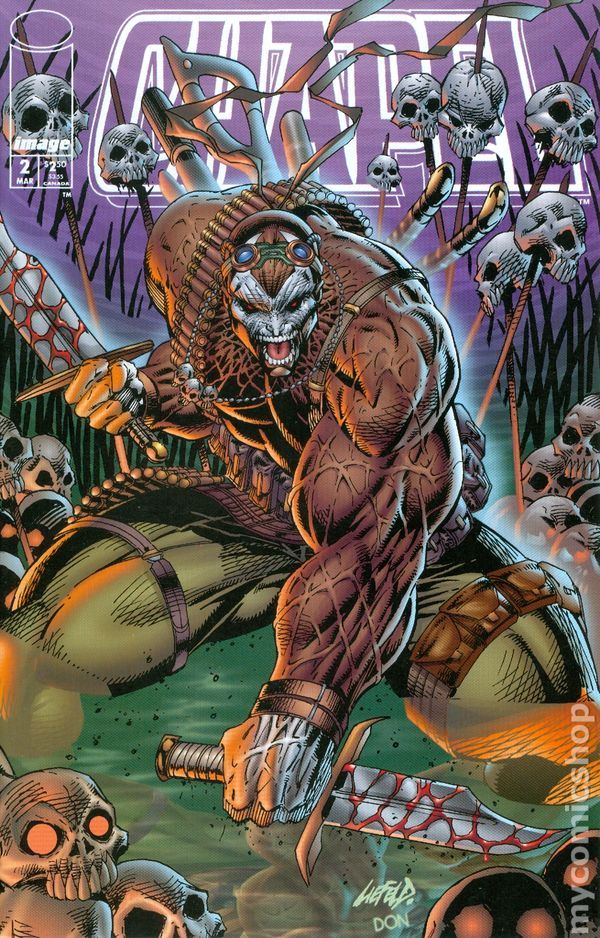
In issue number two, which came out a month later, Chapel, of course, survives the anaconda attack, and the team makes it to a local village where they see that all of the villagers had been slaughtered and had their hearts ripped out. Even Chapel is outraged at the loss of all those innocent civilians and is determined to make Col. Black pay for them. They then get attacked and surrounded by another batch of soldiers, but these are zombies, making them extra difficult to “kill.” Most of Chapel’s team gets killed (like I said: redshirts), and this leads to Chapel’s one-on-one showdown with Col. Black, who does turn out to possess demonic powers.
This series is heavy on action and lots of brutal gun violence, ably illustrated by Tom Tenny and Calvin Irving in the first and just by Irving in the second. It’s like a Rambo movie on paper. The story itself shows that Chapel is not the unfeeling brute that he often appears to be through the anger he feels at the deaths of the villagers and his team members. At one point, he admits to himself that he’s scared. He also shows intelligence in figuring out how to defeat Col. Black. Thus, it’s an entertaining little series for what it is.
Unfortunately, the series is long out of print and not available for sale digitally, but I recommend tracking down copies if you’re a fan of Rob Liefeld’s Extreme Universe characters.
 iBLOGalot